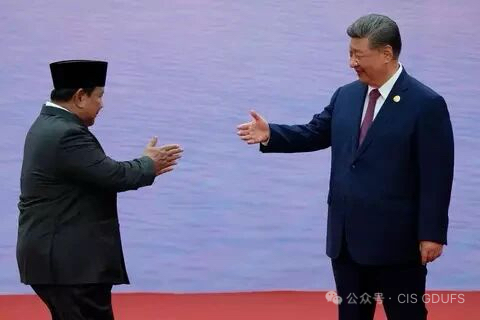
President Prabowo Subianto shakes hands with China's President Xi Jinping before the welcome banquet for the Asia-Pacific Economic Cooperation (APEC) Economic Leaders' Meeting at the Shenzhen International Communication Center in Shenzhen, Guangdong Province on November 18, 2026. (Pool Photo/AFP/Iori Sagisawa)
The APEC Economic Leaders’ Meeting is currently taking place in Shenzhen, China, with Indonesian President Prabowo Subianto in attendance. As Southeast Asia’s largest economy and an APEC founding member, Indonesia has long valued the forum as a critical platform to advance trade and investment liberalization, attract foreign investment, integrate into regional industrial chains, and enhance its voice in global governance.
President Prabowo's trip to China for the APEC meeting represents yet another commitment to and affirmation of multilateralism by Indonesia.
One of Indonesia's key objectives in international economic cooperation is to fully leverage its natural resource endowments. From co-founding APEC in 1989 to proposing the Bogor Goals in 1994, Indonesia helped shape the early direction of APEC. Today, it brings inclusive growth, resource valuation, and digital development into the new regional agenda.Blessed with rich mineral deposits including nickel, copper, aluminum, tin, and coal, Indonesia leads the world in both nickel reserves and output. A major economic challenge for the country lies in building supporting manufacturing capacity and moving up the industrial value chain using these resources.In response, Indonesia has actively promoted the "downstream" development of its resource-based industries in recent years. Seizing opportunities from the global green transition, it has prioritized battery and electric-vehicle manufacturing by tapping into its nickel-ore wealth.These moves have strengthened domestic capacity for raw-material processing, auxiliary industries and downstream consumption, while drawing foreign firms to set up local production facilities, which yields tangible progress.The Asia-Pacific region serves as a crucial pillar for Indonesia's development vision of transitioning from a resource-rich nation to an industrial powerhouse.In terms of manufacturing capabilities, China possesses a comprehensive and large-scale green industrial chain, leading globally in key sectors including photovoltaics, wind power and electric vehicles.South Korea is forging ahead with technologies such as solid-state batteries, sodium-ion batteries and low-carbon materials.Japan, drawing on its solid base in electrification and automation, holds competitive edges in critical equipment and technologies.These factors provide the technological foundation for Indonesia's resource "downstreaming" policy.In terms of consumption capacity, the Asia-Pacific is shifting away from conventional fossil fuels toward clean energy. The international energy crisis triggered by geopolitical conflicts has objectively accelerated the pace of this transition across many countries, opening up a huge market for Indonesia's clean-energy products.Nonetheless, Indonesia's ambition to become an industrial powerhouse also faces headwinds. Amid great-power strategic competition, certain countries have securitized economic cooperation across the Asia-Pacific, obstructing normal commercial activity. As its sizable nickel reserves appear on the critical-minerals list of most nations, Indonesia is especially exposed to this mindset of "over-securitization."Furthermore, some developed economies, having suffered industrial hollowing-out, are deploying stringent environmental rules as green trade barriers to rebuild domestic industrial capacity. This places a disproportionate burden on developing economies.In this context, APEC has emerged as a vital platform for Indonesia to broaden its industrial-development horizons. It has spearheaded trade and investment liberalization and made major headway in reconciling divergent domestic regulations across member economies.Amid mounting trade protectionism and heightening geopolitical strains, APEC has consistently functioned as a stabilizer and connector for Indonesia's trade and economic ties across the Asia-Pacific.Shenzhen APEC's three priorities -- openness, innovation and cooperation -- offer clear guidance for Indonesia as it taps into Asia-Pacific strengths to realize its vision of becoming an industrial powerhouse.First, actively open up to the outside world while ensuring resource sovereignty. Indonesia has long attached high importance to resource sovereignty, expecting resource-derived revenues to benefit its people.Resource-sector development demands heavy capital and technological input. Opening up enables fuller use of its resource endowments to boost national welfare, while remaining compatible with safeguarding resource sovereignty.Second, embrace technological innovations in green industries. Production-related pollution poses a key hurdle to green-industry growth. Decarbonizing industrial power consumption, environmentally sound disposal of industrial waste, and mineral-resource recycling stand out as core priorities for Indonesia going forward.Third, engage in inclusive international cooperation.Indonesia's industrial structure is highly complementary with those across the region, unlocking ample room for joint work. Indonesia's partnership with the Asia-Pacific in its pursuit of industrial-powerhouse status can serve as a meaningful example for building an Asia-Pacific community with a shared future.Under the APEC framework, cooperation betweenIndonesia and China is poised to benefit from a broader window of opportunity. The three priorities of "openness, innovation and cooperation" closely align with Indonesia's development aspirations across multiple areas, creating clear avenues for the two countries to deepen practical cooperation.A key priority of APEC "China year" is to accelerate the green and low-carbon transition by advancing new cooperation initiatives in areas such as clean energy, green minerals and environmental protection.As Indonesia presses ahead with its energy transition and critical minerals downstreaming strategy, China's strengths in technology and industrial capacity across the new-energy supply chain, solar photovoltaics, energy storage, and electric vehicles can offer Indonesia practical and viable avenues for cooperation.Bilateral investment and collaboration in nickel processing, battery supply chains, and renewable energy development could serve as a model for green-growth cooperation under the APEC framework.Xu Liping is the dean of the Institute for Indonesian Studies at Guangdong University of Foreign Studies.Fan Jiaqi is a PhD candidate at the University of Chinese Academy of Social Sciences. Both are columnists for the Global Times, a leading English-language newspaper in China. The views expressed in this article are those of the authors. 本文转载自雅加达环球报,仅作学术信息分享,排版有调整,内容未作改动。版权归原作者所有,如有侵权请联系删除。
原文标题:“How Will APEC Open Up New Development Opportunities for Indonesia?”https://jakartaglobe.id/opinion/how-will-apec-open-up-new-development-opportunities-for-indonesia
复审:左志刚
终审:许利平


